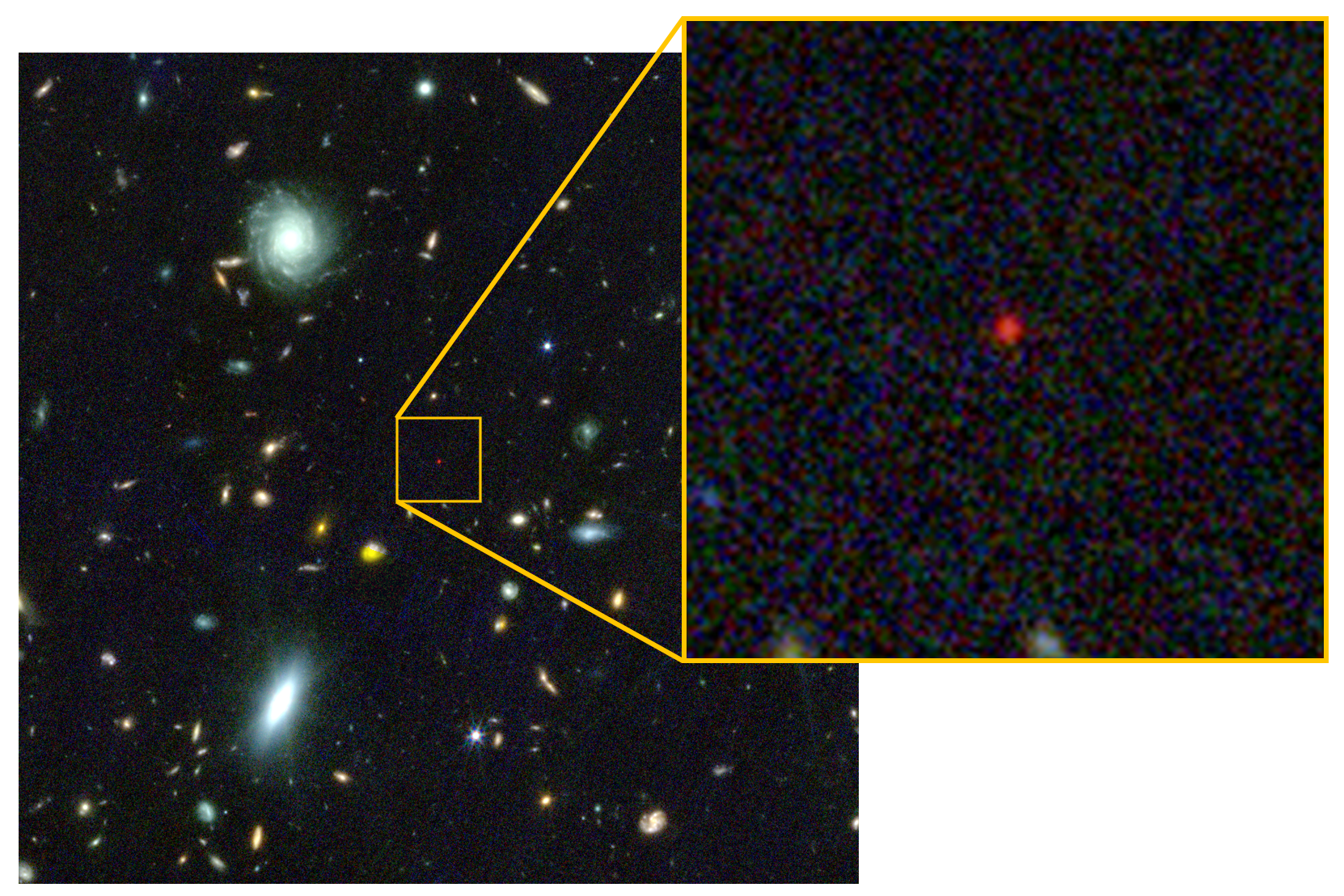
It is only a red point of light. Yet the object behind that point appears to span the size of our solar system and radiate 100 billion times more energy than any known star could physically produce.
The James Webb Space Telescope observed it in the early universe, only 660 million years after the Big Bang. The researchers named it MoM-BH*-1. Their proposed name for the class is stranger still: a black hole star.
“We have found a new type of astrophysical object, a black hole star.”Rohan Naidu · lead author
A star with no fusion at its heart
Ordinary stars are powered by nuclear fusion. MoM-BH*-1 is far too energetic for that explanation.
The model that best matches Webb’s observations places an accreting black hole inside an extraordinarily dense, turbulent cocoon of hydrogen. The black hole supplies the energy. The surrounding gas absorbs and reradiates it, behaving like the immense outer surface of a star.
The result is a paradoxical object: powered like a black hole, but radiating like a star.
The light that disappears
MoM-BH*-1 blazes in Webb’s redder infrared filters, yet seems to disappear at shorter wavelengths. Its spectrum contains the deepest Balmer break yet observed in any object—a drop so extreme that an ordinary population of stars cannot account for it.
The light also shows almost no trace of elements beyond hydrogen and helium. According to the researchers, no known object displays this particular combination of features.
They were hiding in the images
Webb has repeatedly found compact, mysterious objects known as “little red dots.” They appear throughout images of the early universe but largely vanish from later cosmic history.
If the interpretation of MoM-BH*-1 is correct, those dots may represent an entire population of black hole stars caught during a brief and previously unseen phase of their existence.
The beginning of something enormous
Nearly every large galaxy in the present universe contains a supermassive black hole at its center. Astronomers still struggle to explain how some of them grew so large so early.
Black hole stars may offer a missing stage in that story: young black holes feeding inside enormous reservoirs of gas before emerging as the engines of galaxies and quasars.
What looked like a collection of insignificant red points may have been the beginning of the largest structures in the universe.